Being in China, you have to haggle. It can be quite fun, trying to get a good deal, especially when the stakes are low. Haggling is necessary since prices are not posted, so there is no point of comparison, and search costs are high. The first Mandarin I picked up were numbers to help in my bargaining. A student recently asked what the point of learning the numbers was if you can simply tap on a calculator your respective offers. My global answer, not just restricted to China, is twofold. First, responding in the local language signals that you are at least knowledgeable of some words, might have spent some time in the country, and that you are putting forth an effort. The second reason, however, is that when native speakers ask for the price of an item, the response is aural, not on a calculator. I then get more information without engaging with the seller. I still probably do not pay the local price, but at least I do better than the bus full of German tourists.
Tuesday, August 20, 2013
Friday, June 7, 2013
Economic Consulting: Application to Career Starter (by Monica Morariu)
The Capstone Economic Consulting course (G400) with Professor Robert Ridlon in the Business Economics and Public Policy department was a great opportunity to use everything our team learned in our business economics classes and apply it to a real life situation. For the economic consulting capstone, we worked with the co-founders of Career Starter which is a new career competitions website designed to help college students and young professionals launch their careers through competition based hiring.
![]() | |
| Professors Ridlon, Lubensky, Harbaugh, and Hauskrecht listen to presentations by G400 students |
We first developed a strategy that we would run two student-focused campaigns, “internship search” and “full-time job.” Over the three-week period we generated 197 clicks and increased the company’s per-user sign ups by about 73%.
After
analyzing the results of the campaign we realized the potential for low-cost
advertising using Google Adwords for Career Starter and based on this analysis
we gave our client recommendations.
Due to the company being in its infancy and currently has a limited marketing budget, our first recommendation was to continue using AdWords with an emphasis on efficiency of their campaign by focusing on the Internship Ad Group, as the group had a higher click-through-rate and a lower cost for keywords. Once the website has developed a good user base, our second recommendation was for the website to allocate more of their marketing budget to the Full-Time Ad Group as this group received a majority of impressions throughout the campaign. The last recommendation we suggested for Career Starter was once the website has monetized, Career Starter can consider adding additional campaigns that will target Employers and Universities.
Our team was very excited to start the Google AdWords campaign for
Career Starter because not only had none of us worked with AdWords before, but
we were also part of the demographic to which our client is trying to target. This
assignment gave us a unique opportunity to use online advertising with a purely
online business, and essentially develop their online marketing strategy from scratch and
see what we could accomplish.
BEPP Skills to Work in a Real Setting (by Alejandro Arguello)
Not too often have I
gotten the chance to take a class that allows me to apply the skills I have
learned as a BEPP major in a real setting with real money and a real client.
This semester I was fortunate to take my Capstone in Economic Consulting class with Professor Robert Ridlon
and work with a local business in enhancing their online presence. Very much in
like a consulting setting, I was able to apply some of the hard skills BEPP
provides and better prepare for my future career.
![]() | |||
| Jarrod Cook, John Newman, and John Curia present on Sahara Mart |
It all started at the
beginning of the semester when the class was first introduced to the Google
Online Marketing Challenge. The GOMC is an opportunity for students to develop
and run an online advertising campaign with a $250 budget using Google AdWords,
the sponsored links you see when using the search engine.
As we were introduced
to the opportunity, we were given the task to work in teams and find a client
interested in taking part in the challenge. The Uptown Café, a locally owned
restaurant/bar on Kirkwood Ave. would become our partner.
The project started
with a meeting with Michael Cassady, Uptown’s owner, who tasked us with using
AdWords to raise customer awareness of the restaurant and its newly added bar.
As we ventured in the task, we faced different challenges and opportunities
that would draw upon the hard skills BEPP demands.
Among those challenges
were creating a bar section under Uptown’s website for Google searchers to
direct to and analyzing the banks of data gathered from the website’s traffic.
Luckily, we were comfortable working in a team to not only coordinate with professionals
in other fields like Uptown’s web-designer but also in using econometric tools
to better understand Uptown’s online presence and its business environment.
And so we managed to
cope with difficulties and take our project beyond Michael’s initial task.
Through an analysis of Uptown’s competitive environment and the gathered data
from its website, we found opportunities for growth within an online
reservation system and the creation of a mobile friendly webpage.
While preparing for the
final presentation to Michael and the class, we started seeing the parts of the
project coming together to deliver an integrated experience that allowed us to
put the skills we have learned as BEPP majors to work.
At the end Michael was
satisfied with our final recommendations and is now considering implementing
them as Uptown Café moves forward. We were also satisfied to have gotten the
opportunity to apply ourselves in a real setting like the one of Capstone in
Economic Consulting and feel confident will be able to deliver value in the
real world.
Economic Consulting Perspective (by Alexa Larson)
![]() |
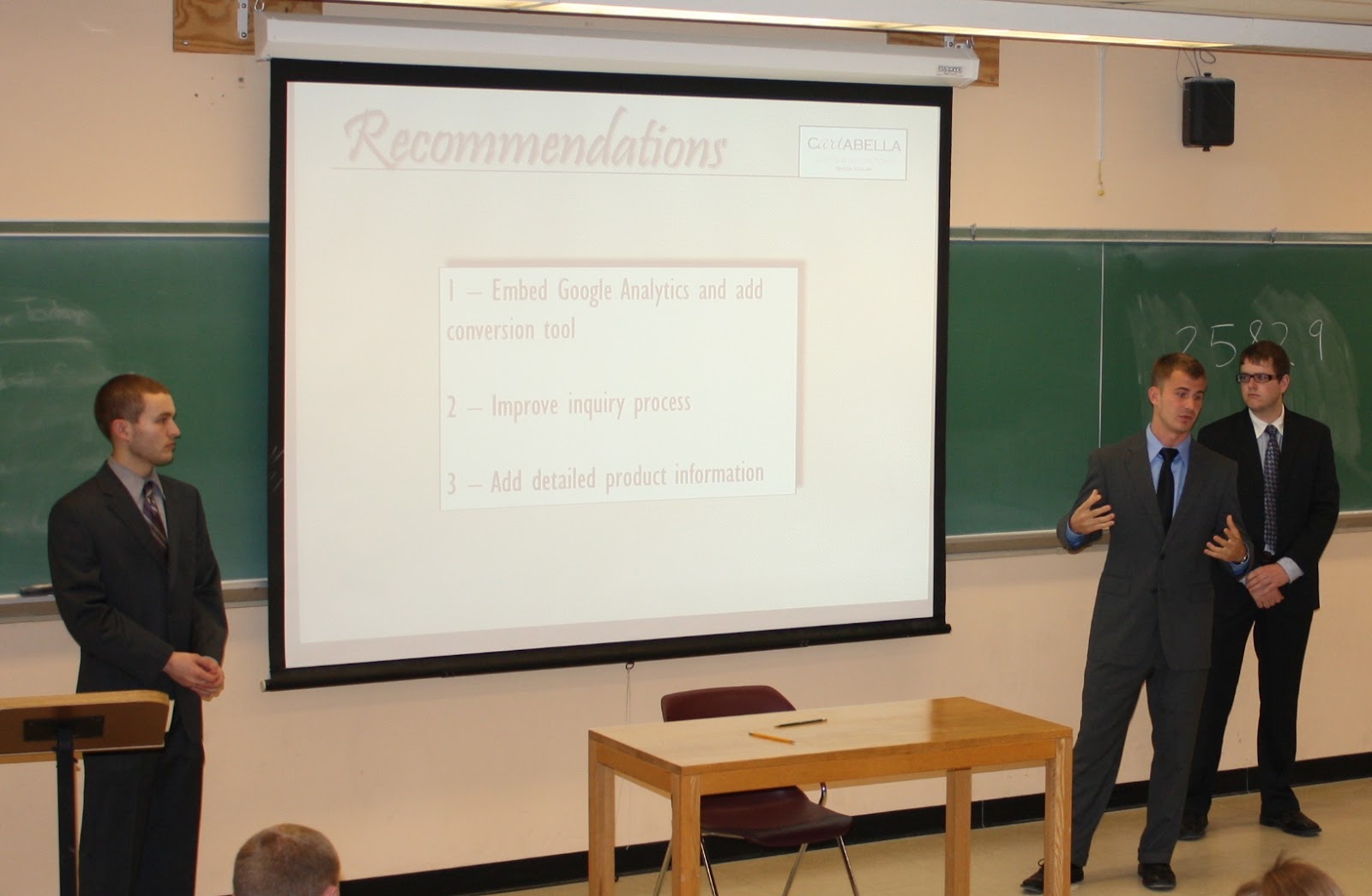
| Brian Paravola, Zach Baily, and Dan Hunt present Cartebella |
This semester I participated in the Economic Consulting course
in the Business Economics and Public Policy department (BEPP) at the Kelley
School of Business. This course is
structured to give students the hands-on experience of analyzing and consulting
by putting their knowledge and skills gained in the BEPP department to work. The
goal was to develop, propose, and implement an online marketing campaign for a client. My team and I partnered with the local
non-profit organization Bradford Woods. We were able to form a solid
relationship with our client, which benefited the effectiveness of our
campaign.
The Business Economics and Public Policy department focuses
its efforts on developing top-of-the-line business leaders. By emphasizing important skills and knowledge
on topics such as non-market risk consulting, managerial economics, game
theory, and data analysis using economic modeling, BEPP educates students
beyond the textbook. Students are then
able to apply these concepts to a multitude of simulations and in this case an
actual project with a client.
The object of the Economic Consulting course taught by Professor Robert Ridlon is to apply
tools students have learned in previous business classes particularly from
Business Economics. In-class lectures
are used to bridge the gap between previous lessons taught in the BEPP
department and actual tasks in the consulting and marketing industries. Lessons
focused on consumer search, bidding auctions, and performance measures.
The course revolves around the Google Online Marketing
Challenge, which calls for teams to develop an online advertising campaign for
a client of their choice using Google Ad Words credited with a $250 budget. Not only are teams participating in this
challenge, critical thinking plays a much larger role behind the scenes. Teams must make strategic decisions while
monitoring their campaign, analyze their data and results, and finally form
optimal recommendations for the client.
When my team and I were deciding on a client, we found that
Bradford Woods had a unique business structure compared to most local
businesses. Bradford Woods is Indiana
University’s outdoor education center. This organization specializes in several
areas including Recreation Therapy, Adventure Education, Environmental
Education, Retreats, and Camps. We decided to take on the challenge of
analyzing how effective online marketing for a non-profit organization actually
is. We targeted the organization’s group
clientele such as other organizations, schools, churches, and corporations by
advertising for their Retreats, Adventure Education, and Camps divisions.
Google AdWords allowed us to observe key success metrics of
our campaign such as the number of impressions, clicks, and the cost of our
keywords and Ads. We were fortunate enough to work with the Director of
Marketing, Tim Street, who then linked us to Google Analytics where we could
examine more specific results of our campaign such as the average duration of a
visit, the number of pages the visitor visited, whether or not it was a new
visitor, and many more.
The project prompted us to be resourceful in how we
monitored our campaign and analyzed our data, and also to be innovative in our
recommendations. We were able to put our
past experiences and skills we’ve gained to work. Communication was key throughout the project,
whether it being with the client or the team as a whole. It was important to remain professional and
respectful while enjoying the connections we were fortunate enough to
make.
While running the campaign our team developed a bidding
strategy for our keywords in order for our Ad Text to return in the top search
positions. With a background in managerial economics we were able to understand
auctions and bidding strategies, and we could compete in this second price
auction against unknown competitors on keywords, while managing our budget as
well. After finishing our campaign we
examined our observations using our previously learned data analysis skills. Some teams ran regressions on the effects of
their costs per clicks, while we looked at differences in seasonality and the
effects our campaign had on visitors’ interactions on the website. In the end,
we were able to act as consultants and form solid conclusions and
recommendations in which our client can use as an advantage for future
decisions of the organization.
Although not all team recommendations were to pursue an
AdWords campaign for their client, students have benefited from the valuable
lessons and experience of taking this course. Working with ambiguity and having
the control to make decisions allows teams to be innovative and use the
critical thinking skills we have developed to overcome unexpected challenges.
Economic Consulting gives students the opportunity to practice what they’ve
studied, and being able to apply what we have learned throughout the course of
our college career has been very beneficial.
Labels:
Economic Consulting
Location:
Bloomington, IN, USA
A Taste of Consulting with a Flavor of Google (by Rob Jiang)
“Experience is the
best teacher.” Typically, courses are taught from a high-level theory perspective,
this is especially true in the realm of economics. Don’t misunderstand, academic
learning is fantastic – understanding business concepts, learning to solve case
questions, and following historical progressions, But there is one caveat.
Often I find
myself wondering how I can apply what I have learned to what I would be doing
in the real world. A consistent, slight distaste seems to linger with me:
having diligently studied and paid attention all semester, I leave final exam
rooms often without the notion of how I can use those learnings in my future.
![]() |
| Rob Jiang and Jay Trewn present about their client GamerFront |
From day one,
students sought out various clients that they could provide their analytical,
creative, and problem-solving skills by means of Google’s AdWords program. The clients came from a broad range industries that
included non-profit child development, online job market, online gaming,
restaurant, health and spa, and investment management.
Professor Ridlon
provided several debriefing lectures and offered assistance throughout the
semester, but the seven teams worked autonomously for the overwhelming majority:
engaging the clients with proposals, interacting with the proper client
personnel, developing a business strategy limited by a 250 dollar Google
allocated budget, execution of that strategy, and ultimately providing a
business recommendation that clients can actually use. Students got the
opportunity to receive a comprehensive taste of consulting from start to finish.
As a business
economics and public policy senior in my final semester, the experience was
great in many ways. First, the project applied much of the course work that I
have previously taken. Game theory, managerial economics, technology in
business, and many more classes played a large role in the teams’ development
of strategy and economic analysis that led to business recommendations. The
capstone nicely ties together Kelley curriculum, especially classes within the
BEPP department.
Additionally,
understanding the process of client engagement has been invaluable. During
client meetings, we quickly learned that the client is not always entirely
certain of their own needs. In fact, we found a primary reason for hiring a
consulting group is to help them identify goals. We eventually understood that
to be successful, it is essential to be significantly patient, intentionally questioning,
and consistently flexible in order to tailor a unique strategy to unique
business requirements. I highly doubt a cookie-cutter approach would have been
sufficient for any of the clients.
Our client, like
many others, truly appreciated the work that these Kelley students were doing,
and they certainly expressed that sentiment. “This project has provided us with
very valuable business intelligence that we would have otherwise needed to pay
to receive,” said Chris Barr of GamerFront. At the completion of the various Google
advertising campaigns, a final satisfaction derived from the clients and all
their positive feedback. These organizations were particularly elated to have
actual, usable business intelligence at the conclusion. The free Google
advertising and consulting time was just icing on the cake.
Subscribe to:
Posts (Atom)
.jpg)
.jpg)
.jpg)
.jpg)